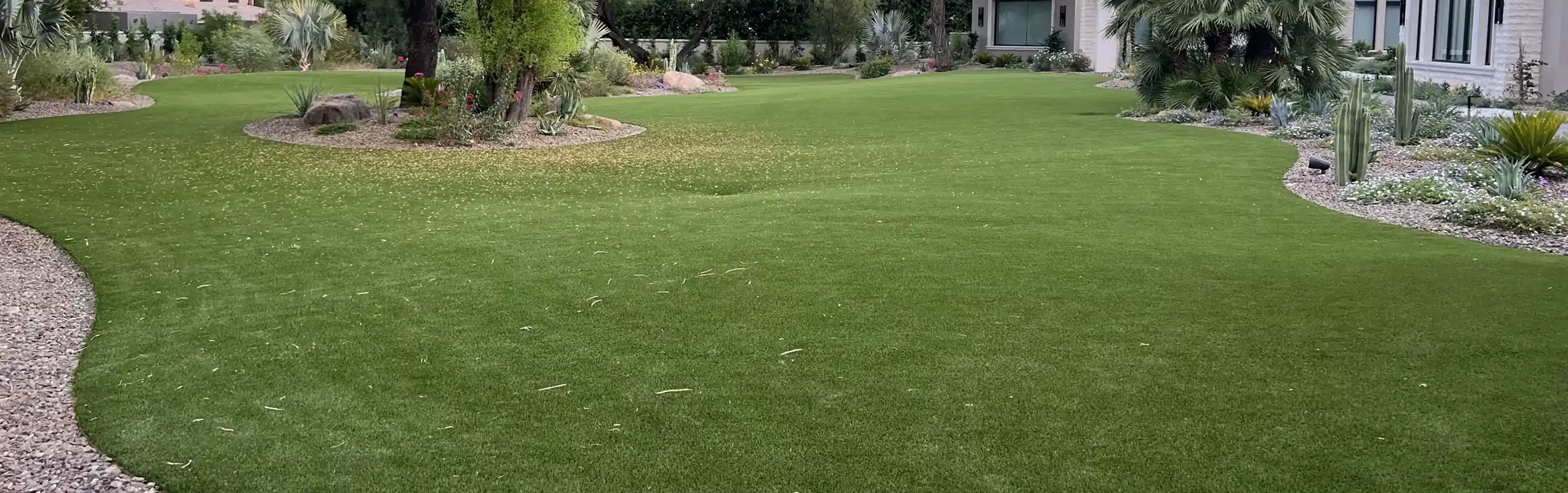
Service Overview
Commercial Artificial Turf Installation in Richmond means planning around the specific ground conditions found across Fort Bend County's wide commercial and mixed-use landscape. Properties near FM 762 and the Long Meadow Farms corridor often sit on flatter terrain with variable drainage patterns depending on lot grading and proximity to drainage easements. Before any turf is set, Turf Installation of Richmond evaluates drainage flow, staging access, surface traffic expectations, and perimeter transitions so the project scope matches the actual site — not a generic estimate.
Pecan Grove Plantation's commercial frontage along FM 359 presents a different challenge: mature post oaks and pecans with wide-spreading surface roots that require careful base preparation to avoid lifting seams after installation. The Trees of Distinction designation in parts of Pecan Grove means preserving root zones while still delivering a clean, finished turf surface — a balance that demands experienced field judgment, not just standard equipment.
For business owners along US-90A, in Rosenberg's eastern commercial strips, or in the newer mixed-use sections of Aliana and Cross Creek Ranch, the decision to install commercial artificial turf often comes down to ongoing landscape maintenance costs versus a one-time installation investment with predictable upkeep. Turf Installation of Richmond scopes each commercial project with those long-term economics in mind: preparation depth, drainage architecture, edge stabilization, and infill selection are all chosen to minimize future intervention and maximize usable surface life.
From first-site walkthrough through final verification, every scope item is documented in plain language. Property managers and business owners receive a realistic timeline, a written sequence of work phases, and clear guidance on how the finished turf integrates with surrounding concrete, decomposed granite, or existing landscape beds. Our crews coordinate with property access schedules so commercial operations experience minimal disruption during installation.
What Is Included in Commercial Artificial Turf Installation
Each commercial project is scoped to match site conditions across Richmond and the surrounding Fort Bend County service area. Typical scope items include:
Site Assessment and Drainage Mapping
Field evaluation of slope direction, drainage behavior, and surface water paths before any preparation begins.
Root Zone and Soil Analysis
In tree-dense areas like Pecan Grove Plantation, base preparation accounts for surface root influence on long-term seam stability.
Base Preparation and Compaction
Crushed aggregate base installed and compacted to specified depth based on traffic load and drainage requirements.
Turf Material Selection
Blade weight, pile height, and infill type selected based on usage profile, traffic density, and maintenance goals.
Installation with Seam and Edge Control
Turf panels placed, seamed, and secured with perimeter stabilization matched to surrounding hardscape or landscape transitions.
Final Walkthrough and Maintenance Guidance
Completed scope reviewed on-site with written notes on upkeep intervals, infill management, and surface care.
Commercial Installation Process
Our installation workflow for commercial properties in Richmond and Fort Bend County follows a structured sequence that protects surface quality and minimizes operational disruption.
1. Property Walkthrough and Constraint Assessment
We walk the site, confirm drainage paths, identify staging access, and document constraints including tree root zones, perimeter hardscape, and irrigation infrastructure.
2. Written Scope and Material Specification
A project scope document outlines preparation depth, turf specification, drainage approach, and edge detailing before any work begins.
3. Base Demolition and Preparation
Existing vegetation is removed, the base is graded to promote drainage, aggregate is installed and compacted to the specified profile.
4. Turf Installation and Seaming
Turf panels are placed in a controlled sequence. Seams are positioned away from high-traffic lines. Perimeter edges are secured to match adjoining surfaces.
5. Infill and Surface Finishing
Infill material is distributed and worked into the pile. Turf blade orientation is confirmed and surface irregularities are addressed.
6. Final Inspection and Documentation
Completed work is reviewed against scope. Maintenance guidance is provided. Access is returned to normal property operations.
Commercial Turf Applications in Richmond and Fort Bend County
Commercial artificial turf installation serves a wide range of property types across Richmond, Rosenberg, Fulshear, and surrounding communities.
Business Park Entries and Grounds
Office and light-industrial properties along US-90A and FM 762 where consistent curb appeal with minimal maintenance is a priority.
Retail Center Landscaping
Shopping center outparcels and strip centers in Rosenberg and Richmond where turf reduces irrigation costs and grounds crew frequency.
Hospitality and Event Venue Grounds
Properties in the George Ranch and Pecan Grove areas where outdoor event space requires a surface that stays green and clean through heavy event traffic.
HOA Common Areas and Entry Features
Shared spaces in established communities like Pecan Grove Plantation and Long Meadow Farms where appearance standards are enforced and natural grass struggles under traffic and shade.
Why Commercial Operators Choose Turf Installation of Richmond
Commercial property managers across Fort Bend County choose Turf Installation of Richmond because we understand the planning requirements unique to larger-lot and mixed-use commercial sites. Our crews have worked in Pecan Grove's tree-dense sections, along the FM 359 commercial corridor, and in newer Fulshear business parks where soil conditions and drainage architecture vary block by block. We do not apply a single base-prep formula to every job — each site gets a field-driven scope that reflects actual drainage behavior and traffic loading. That approach produces finished surfaces that hold up through Fort Bend's weather cycles and heavy commercial use without requiring frequent corrective intervention.
Factors That Affect Commercial Project Scope
Commercial turf installation pricing reflects measurable site conditions. Key factors include:
Total Square Footage and Layout Complexity
Irregular shapes, interior cut-outs around landscape beds, and multiple zones increase material waste and labor time.
Base Preparation Requirements
Sites with compacted caliche, high clay content soils, or surface root interference require deeper or more involved base work.
Drainage Infrastructure
Properties with existing drainage constraints or no natural grade may require additional aggregate depth or channel integration.
Equipment and Staging Access
Tight access points, underground utilities, or proximity to occupied structures affect equipment selection and production pace.
Turf Specification
Higher-traffic commercial applications typically require heavier-face-weight turf with more resilient infill, which affects material cost.
Service Area Coverage
Turf Installation of Richmond provides commercial turf services throughout Richmond and Fort Bend County, including Pecan Grove Plantation, Long Meadow Farms, Rosenberg, Fulshear, Sugar Land, Missouri City, Needville, Simonton, Orchard, Wallis, Brookshire, and the Greater Houston western periphery along I-10 and US-90A.
Frequently Asked Questions
How does Turf Installation of Richmond handle tree root zones on commercial sites in Pecan Grove?
We evaluate surface root spread during the site assessment and adjust base preparation depth and aggregate mix to minimize root pressure on the sub-base. In areas with significant root presence, we document the approach and discuss long-term monitoring expectations with the property manager.
Can commercial turf installation be phased to keep part of a property operational?
Yes. For larger commercial footprints, we can sequence installation by zone so access to portions of the property is maintained throughout the project. Phasing is documented in the initial scope.
How long does a typical commercial artificial turf installation take in Richmond?
Timeline depends on total area, site preparation requirements, and access. After the walkthrough, we provide a realistic schedule range rather than a generic number. Most mid-sized commercial projects in the Fort Bend area are completed within three to seven business days of preparation start.
Does commercial turf hold up under heavy foot traffic in a Texas climate?
Yes. We specify turf face weight, blade type, and infill selection based on expected traffic loading. Commercial-grade turf installed on a properly prepared base handles high-frequency pedestrian traffic reliably through Fort Bend's weather cycles.
Is irrigation removal required before commercial turf installation?
Existing irrigation lines under the installation zone are typically capped or removed during preparation. We document irrigation infrastructure found during base work and confirm the approach with the property contact before proceeding.
What maintenance does commercial artificial turf require?
Routine maintenance includes periodic debris removal, infill redistribution in high-traffic zones, and drainage inspection after significant rain events. We provide a written maintenance guide at project completion.