Service Overview
Artificial Turf Repair in Richmond requires understanding the failure mechanism before committing to a repair approach. The wrong repair on a turf seam that failed because of sub-base movement will fail again. Turf Installation of Richmond begins every repair engagement with a diagnostic walkthrough to identify what actually caused the problem before work begins.
In Pecan Grove Plantation, the most common repair requests involve edge lifting along perimeter borders where surface roots from mature pecan and post oak trees have grown under the base aggregate and displaced the turf edge anchor. Cosmetic re-stapling without addressing the root intrusion will produce the same failure within months. We evaluate root pressure depth, decide whether the base perimeter can be modified or whether a different edge anchoring system is needed, and explain the options before repair begins.
Long Meadow Farms equestrian-section properties and large-lot residential properties near Simonton and Booth sometimes see seam separation caused by sub-base settling on soft or organic-rich soils. Older turf installations that did not use adequate base compaction are particularly vulnerable after wet seasons when soil below the aggregate can shift. Repair scope in these cases often includes reopening the seam, evaluating sub-base condition, adding aggregate or stabilizing the base profile, and re-seaming with appropriate adhesive and seam tape.
For residential properties in Mission West, George Ranch, and other Richmond neighborhoods where children's play equipment sits on or adjacent to turf, wear damage in concentrated areas — around swing posts, slide exits, and gate entries — is a common repair scenario. Localized patches matched to the original turf specification handle these repairs cleanly when the surrounding surface is still in serviceable condition. Turf Installation of Richmond carries patch material in common specifications to minimize color and texture mismatch on repairs.
What Is Included in Artificial Turf Repair
Repair scope is determined by the diagnostic assessment of each specific damage type and location. Standard scope items include:
Damage Diagnostic and Root Cause Assessment
We evaluate the failure mechanism — root intrusion, sub-base settling, infill depletion, seam adhesive failure, or mechanical damage — before specifying repair approach.
Edge and Perimeter Repair
Lifted edges are re-anchored after root intrusion or soil movement is addressed. Edge border systems are evaluated and replaced if the original anchoring method is no longer suitable.
Seam Repair and Re-bonding
Failed seams are opened, sub-base condition is confirmed, seam tape and adhesive are replaced, and turf panels are re-joined with proper alignment.
Patch Installation for Localized Damage
Worn or mechanically damaged turf sections are removed and replaced with matched patch material. Surrounding turf condition is evaluated to determine whether partial or full section replacement is more practical.
Sub-base Correction
Where base settling or root displacement has caused the failure, sub-base aggregate is added or recompacted before turf is re-laid.
Post-Repair Inspection and Documentation
Completed repair is inspected for surface alignment, seam continuity, and drainage performance. Findings and work performed are documented.
Turf Repair Process
Our repair process in Richmond and Fort Bend County prioritizes diagnosing the actual failure cause before any repair work begins.
1. Diagnostic Site Visit
We visit the property, walk the affected area, probe sub-base condition where relevant, and evaluate root or soil influence on the failure.
2. Repair Scope Documentation
We describe what caused the failure, what the repair involves, and what the realistic outcome is — including whether the repair is likely to hold long-term given site conditions.
3. Area Preparation
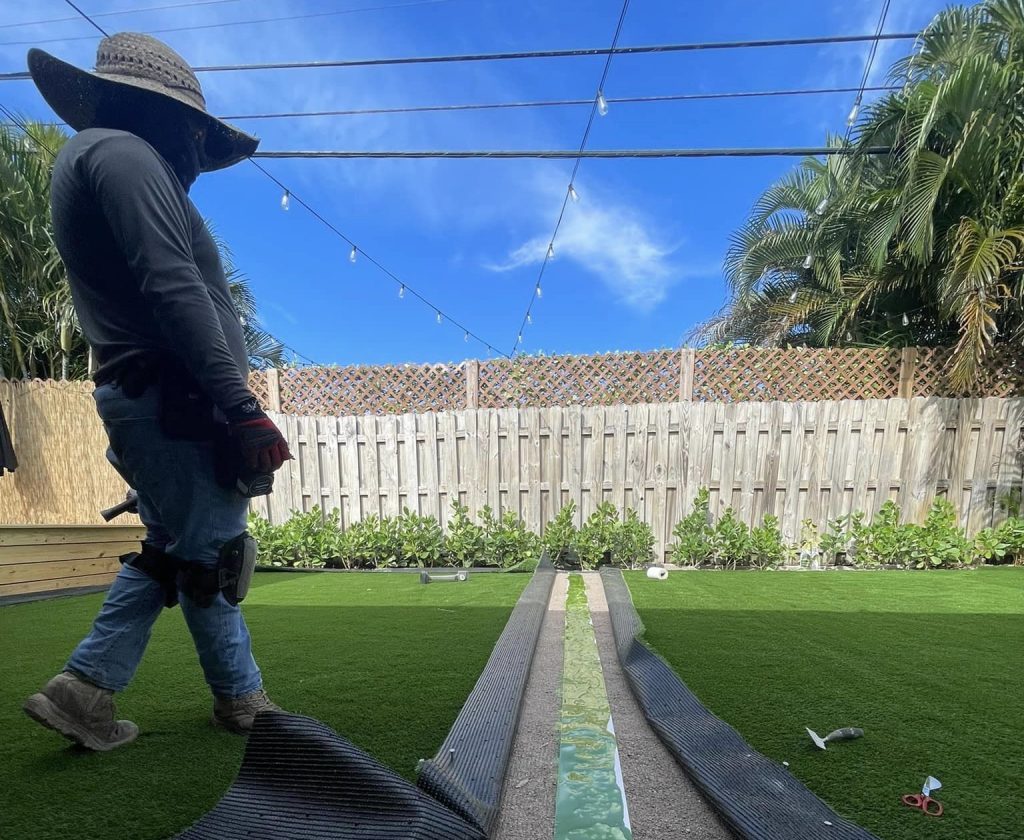
Affected turf is carefully peeled back, sub-base condition is evaluated and corrected as needed, and root intrusion or soil issues are addressed before re-laying turf.
4. Repair Execution
Seam, edge, or patch work is completed using appropriate materials. Color and texture match to surrounding turf is confirmed before final adhesion.
5. Final Inspection
Repaired area is walked and inspected. Surface alignment, seam quality, and drainage flow are confirmed before the crew leaves the site.
Common Turf Repair Scenarios in Richmond and Fort Bend County
Repair requests across Richmond neighborhoods typically fall into several recognizable categories.
Root-Lifted Edges in Pecan Grove Plantation
Mature pecan and post oak roots that have grown under aggregate base and lifted perimeter borders require root-aware edge repair that addresses the root path rather than just re-securing the surface.
Seam Separation on Large-Lot Properties
Long Meadow Farms and Simonton-area large-lot properties sometimes experience seam separation caused by sub-base settling on soft or variable soils. Re-seaming with corrected sub-base is the appropriate repair approach.
Wear Patches in High-Traffic Family Yard Areas
Concentrated wear around play equipment, pet gates, and run entrances in Mission West and George Ranch neighborhoods is addressed with localized patch replacement matched to surrounding turf specification.
Infill Displacement and Pile Matting
Heavily compacted zones on commercial and high-use residential properties that have lost structural infill benefit from infill restoration and pile grooming. Full repair may not be needed if the turf face is still intact.
Why Correct Diagnosis Matters for Turf Repair in Fort Bend County
Property owners across Pecan Grove Plantation, Long Meadow Farms, and the broader Richmond area have called Turf Installation of Richmond after previous repair attempts failed to hold. In most cases, the reason was that the surface symptom was repaired without addressing the underlying cause. Lifting edges in Pecan Grove almost always involve root pressure that will re-displace any anchor not designed to accommodate root growth. Seam failures on large Fort Bend lots frequently point to sub-base settling that will recur unless the aggregate profile is corrected. We tell property owners what we found and what we recommend before work begins, and we are direct when a partial repair is not likely to hold long-term.
Factors That Affect Turf Repair Scope
Repair pricing reflects the actual failure type and site conditions. Key factors include:
Failure Type and Root Cause
Edge lifting, seam failure, mechanical damage, and infill depletion each involve different materials and labor. Root cause determines what the repair actually entails.
Sub-base Correction Requirement
Repairs that require opening the sub-base, adding aggregate, or addressing root intrusion involve more labor and time than surface-only repair work.
Affected Area Size
Localized patches are less expensive than wide seam repairs or full section replacements. Total repair area is confirmed during the diagnostic visit.
Turf Match Availability
Older or discontinued turf specifications may require creative matching. We evaluate color and texture match options during the diagnostic assessment.
Access and Site Constraints
Properties with tight access or complex perimeter conditions — common on long-established Pecan Grove lots — may require additional setup time.
Service Area Coverage
Turf Installation of Richmond provides artificial turf repair service throughout Richmond and Fort Bend County, including Pecan Grove Plantation, Long Meadow Farms, Mission West, George Ranch, Rosenberg, Fulshear, Sugar Land, Needville, Simonton, Orchard, Wallis, Brookshire, and surrounding communities.
Frequently Asked Questions
How does Turf Installation of Richmond handle edge repairs in Pecan Grove Plantation where tree roots keep lifting the border?
We evaluate root growth depth and trajectory during the diagnostic visit. Depending on root pressure, we may recommend a modified edge anchoring system, a root barrier at the perimeter, or a combination approach that accommodates ongoing root growth without recurring edge lift.
Can a seam be repaired without replacing the entire turf section?
In most cases yes, if the surrounding turf is in acceptable condition. We open the seam, correct sub-base issues if present, and re-bond with appropriate seam tape and adhesive. If the turf face adjacent to the seam is also degraded, partial section replacement may be more practical.
How long does a typical turf repair take?
Most localized repairs — edge sections, single seams, small patches — are completed in a half-day to full-day visit depending on the required sub-base work. Complex repairs involving large sub-base correction may take longer. We provide a timeline estimate after the diagnostic visit.
What if the turf specification for my original install is no longer available?
We evaluate color and pile height match options during the assessment. In many cases, a sufficiently close match is available. When it is not, we discuss options including full section replacement or blended approaches that minimize visible difference.
Is repair worth it, or should I consider replacement for older turf?
We make an honest assessment during the diagnostic visit. If the turf surface has widespread degradation — face weight loss, UV discoloration across large areas, or sub-base failure in multiple locations — we will tell you that replacement is likely more cost-effective than repair.
Do you repair turf on commercial properties in Richmond and Rosenberg?
Yes. We provide repair service for commercial artificial turf installations on business properties throughout Fort Bend County.